Updated: July 2026
Nusa Penida vs Tulamben: Best Bali Dive Trip Location?
- Choose Nusa Penida for encounters with Mola mola, majestic manta rays, and navigating thrilling currents.
- Choose Tulamben for macro photography, muck diving, and the historical gravitas of a major wreck.
- Consider Your Skill: Penida’s conditions often demand advanced certification, whereas Tulamben is welcoming to all levels.
The water shifts from sapphire to a deep, electric blue as you descend. Your focus narrows to the rhythmic hiss of your regulator and the dance of light filtering from the surface. In one version of this moment, you are a projectile, carried by a powerful, unseen current along a vertical wall teeming with life, your eyes scanning the abyss for giants. In another, you are nearly motionless, fins dusting volcanic sand, your gaze fixed on a creature no larger than your fingernail, a perfectly camouflaged pygmy seahorse. This is the essential choice confronting the discerning diver in Bali. It’s the exhilarating velocity of Nusa Penida versus the meditative stillness of Tulamben. As an editor who has logged dozens of dives in both, I can tell you the decision isn’t about which is better, but which is right for the soul of your specific journey.
The Vibe: Adrenaline Currents vs. Volcanic Calm
The fundamental character of a dive destination is shaped as much by its underwater topography as its topside atmosphere. Nusa Penida, an island separated from Bali’s mainland by the formidable Badung Strait, is defined by raw, untamed energy. The journey itself, a 30 to 45-minute speedboat ride from Sanur, feels like an expedition. On the island, life is dictated by the ocean’s mood. The dive briefings here are serious affairs, with detailed discussions of currents that can change direction and intensity without warning, sometimes exceeding 4 knots. My long-time guide, Wayan Sudira, always says, “In Penida, we don’t dive against the ocean; we ask for permission to join its dance.” This is a place for the confident diver, one who finds a thrill in surrendering to the power of the sea. The experience is one of high stakes and even higher rewards, a true adventure in every sense.
Conversely, Tulamben, a three-hour scenic drive from the airport to Bali’s northeast coast, exudes a profound tranquility. It’s a quiet fishing village that lives in the immense shadow of Mount Agung, the island’s highest and most sacred volcano, which stands at 3,031 meters. The diving here is almost exclusively shore-based. You gear up meters from the water, walk across a beach of smooth, black volcanic stones, and simply descend. There’s no rush, no boat schedule to meet. The pace is dictated by your own curiosity and air consumption. The atmosphere is contemplative, encouraging slow, meticulous exploration. It’s a destination that appeals to the underwater naturalist, the photographer, and the diver seeking a peaceful escape. The choice in your bali dive trip nusa penida vs tulamben comparison often begins here: do you seek the heart-pounding rush of the unknown or the deep satisfaction of patient discovery?
The Main Attraction: Pelagic Giants vs. The Ghost Fleet
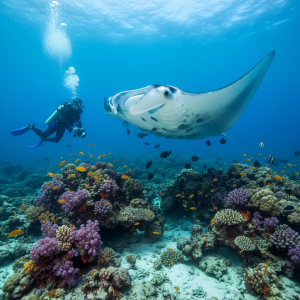
Every world-class dive region has its icon, the one experience that fills logbooks and fuels conversations. For Nusa Penida, the main draw is the high probability of encountering marine megafauna. The dive site Manta Point is aptly named; it’s a cleaning station where majestic reef mantas, with wingspans reaching up to 5 meters, congregate to have parasites removed by smaller fish. The experience of hovering as these gentle giants glide effortlessly around you is nothing short of sublime. Yet, the island’s most enigmatic resident is the oceanic sunfish, or Mola mola. From roughly July through October, when colder water from the deep upwells, these bizarre and massive creatures, weighing up to 2,300 kilograms, ascend to the cleaning stations at sites like Crystal Bay. Seeing a Mola is a true badge of honor for any diver, a moment of sheer, unadulterated awe. These encounters are what make Penida a bucket-list destination for pelagic lovers.
Tulamben’s centerpiece is a relic of human history, now fully claimed by the sea. The USAT Liberty Wreck is arguably one of the most famous and accessible shipwrecks in the world. A 125-meter-long US Army transport ship torpedoed by a Japanese submarine in 1942, it was beached at Tulamben before a 1963 eruption of Mount Agung pushed it back into the sea. Today, it rests on a sand slope in depths from 5 to 30 meters, making it accessible to divers of all certification levels, including snorkelers. Dropping onto the wreck at sunrise to witness the resident school of bumphead parrotfish depart for their daily foraging is a quintessential Bali diving ritual. The entire structure is encrusted with corals and sponges, a living museum patrolled by schools of trevally and surgeonfish. It offers endless opportunities for exploration, from its swim-throughs to its intact cargo hold, and is a world-class night dive. The choice here is stark: the living, breathing giants of Penida or the silent, coral-draped ghost of Tulamben.
A Diver’s Bestiary: What You’ll Actually See
Beyond the headliners, the biodiversity in both locations is staggering, though wildly different in scale and focus. A typical dive day around Nusa Penida’s northern sites, like SD Point or Pura Mas Gading, involves drifting along dramatic, coral-covered walls. You are part of the scenery, a spectator in a grand parade. Schools of fusiliers, numbering in the thousands, flow like rivers. Giant trevallies, dogtooth tuna, and the occasional reef shark patrol the blue. Sea turtles, particularly hawksbill and green turtles, are a common sight, often seen resting on ledges or munching on sponges. The coral health is generally excellent, with vast fields of staghorn and table corals. The focus is macroscopic; you’re looking for big animals and large-scale seascapes. It’s about the sheer volume and energy of the reef system, a powerful testament to the nutrient-rich waters of the Indonesian Throughflow, a current that funnels water from the Pacific to the Indian Ocean.
Tulamben, on the other hand, invites you to zoom in. The volcanic black sand, which might seem barren at first, is a treasure trove for muck diving enthusiasts. This is where you hunt for the weird and the wonderful. At sites like the Seraya Secrets or Melasti, your guide will point out wonders you would never find on your own. I’ve spent entire 70-minute dives within a 20-square-meter area, mesmerized by the finds: harlequin shrimp feeding on starfish, flamboyant cuttlefish displaying their hypnotic colors, and more species of nudibranch than one can count. The USAT Liberty wreck itself is a microcosm of this, hosting pygmy seahorses on its sea fans and ghost pipefish hiding in plain sight. The experience in Tulamben is a lesson in observation. It trains your eye to appreciate the minute, the bizarre, and the brilliantly camouflaged. Our Bali Diving Packages Atelier — Curated Multi-Day Dive Itineraries Tulamben Nusa Penida are designed to maximize these unique encounters.
Conditions and Topography: The Unseen Forces
Understanding the underwater environment is critical to planning a safe and enjoyable dive trip. Nusa Penida’s diving is defined by its exposure to the open ocean and the deep Lombok Strait. This results in consistently strong and often unpredictable currents. While these currents are the very reason for the abundance of marine life, they demand respect and experience. Water temperatures can also be surprising, dropping to a brisk 20-24°C during the Mola season, necessitating a 5mm wetsuit. The topography consists primarily of steep walls, deep canyons, and sloping reefs that can drop off into the abyss. Visibility is often excellent, frequently exceeding 30 meters. Due to the combination of depth, strong currents, and cooler water, a minimum of an Advanced Open Water certification and recent diving experience is strongly recommended. Many of the premier sites are simply not suitable for novice divers.
Tulamben offers a much more forgiving and controlled environment. on the sheltered northeast coast, the area is protected from the powerful currents that sweep past Penida. Dives are characterized by calm, placid conditions with minimal to no current, making it an ideal location for training, night diving, and underwater photography. The water is consistently warmer, typically ranging from 27-29°C year-round. The topography is a gentle, continuous slope of black volcanic sand and rock, punctuated by coral bommies and artificial reef structures. The ease of access is a major selling point; the world-class Liberty Wreck is a mere 30-meter walk from the shore. This accessibility makes Tulamben a haven for divers of all levels, from those taking their first breaths underwater to seasoned technical divers exploring the deeper sections of the drop-off. When planning your Bali dive trip, this contrast in conditions is one of the most important factors to consider.
Life Above the Waterline: Island Ruggedness vs. Village Tranquility
Your time on dry land is an integral part of the experience, and the surface intervals in these two locations could not be more different. Nusa Penida is an island of dramatic, raw beauty. Its coastline is famous for jaw-dropping limestone cliffs that plunge into turquoise water, best exemplified by the iconic Kelingking Beach viewpoint. The interior is a rugged, hilly landscape of small villages and farms. While tourism is developing rapidly, it still retains a rustic, adventurous feel. Exploring the island on a scooter, discovering hidden beaches like Diamond Beach or natural infinity pools like Angel’s Billabong, is an adventure in itself. The accommodation and dining options range from simple guesthouses to a growing number of chic boutique hotels and wellness retreats. The vibe is young, energetic, and geared towards the intrepid traveler, as highlighted by the official Indonesia tourism board.
Tulamben offers a different kind of escape: one of peace and cultural immersion. This is not a place for nightlife or extensive sightseeing. It is a small, working Balinese village where life moves at a slower pace. The days are structured around diving, relaxing by the pool, and perhaps enjoying a traditional Balinese massage. The dominant feature of the landscape is the majestic Mount Agung, a constant and humbling presence. The local culture is palpable, from the daily offerings placed on the shore to the sounds of gamelan music drifting from a nearby temple. Accommodation consists mainly of dive-centric resorts that cater to every need, from camera rooms to expert-led workshops. The appeal of Tulamben is its simplicity and its focus. It’s a place to fully immerse yourself in diving and disconnect from the frantic pace of the outside world, making it a perfect component of our luxury bali diving packages.
Quick FAQ: Bali Dive Trip Nusa Penida vs Tulamben
Which location is better for a beginner diver? Without a doubt, Tulamben. Its calm, current-free shore dives provide a safe and confidence-building environment, while still offering world-class marine life on sites like the USAT Liberty Wreck and the Coral Garden.
Do I need an Advanced Open Water certification? It is highly recommended for Nusa Penida. Many of the key sites, including those for Mola mola, are deeper than the 18-meter limit for Open Water divers, and managing the strong currents requires a higher level of skill and comfort in the water. Tulamben is perfectly suited for all certification levels.
When is the absolute best time to visit? The dry season, from April to October, generally offers the best weather and surface conditions for both locations. For the specific goal of seeing Mola mola in Nusa Penida, you must target the colder water season between July and October.
Can I dive both Nusa Penida and Tulamben on the same trip? Yes, and it creates a wonderfully comprehensive Bali dive experience. We recommend a minimum of 10 days to do it comfortably, allowing for travel time between the locations (approximately 4-5 hours portal-to-portal) and sufficient time to enjoy the unique offerings of each. A perfectly tailored Bali dive adventure can easily incorporate both.
Ultimately, the debate of Nusa Penida vs. Tulamben is not about crowning a winner, but about personalizing your adventure. Do you crave the thrill of the drift, the chance to share the water with giants, and the raw beauty of a rugged island? Or does your ideal trip involve serene, meditative explorations of a historic wreck and the patient hunt for impossibly small, beautiful creatures in a tranquil village setting? Each offers a profound connection to the ocean in its own distinct dialect. At Bali Diving Packages Atelier, we specialize in translating your desires into a seamless itinerary, whether it’s an adrenaline-fueled expedition to Penida, a tranquil retreat to Tulamben, or a perfectly balanced journey that captures the very best of both worlds. Explore our curated bali diving packages and let us craft the underwater Indonesian escape you’ve been dreaming of.